Sunday, October 28, 2012

Chapter 8 Vocabulary & Terms

prophet
Moses
Noah
a man who people in the Jewish, Christian, and Muslim religion believe was sent  by God to teach them or lead them
clan
a group of related families 
tribe
a social group where people share the same traditions, culture, and leadership
polytheist
a person who believes that there is more than one God
monotheism
the belief in one God
convert
someone who changes beliefs, especially those about religion
boycott
a refusal to do business with an organization or group
siege
an attempt to surround a place, not letting anyone in or out while trying to gain control of that place
People of the Book
a term for non-Muslims (Christians and Jewish) who share the belief in the Torah; the Torah is the holy book for  the Jewish faith,  it is the first half of the Bible (the Christian holy book), and it is considered to be the inspired word of God by Muslims... all three faiths share the same early prophets
 dynasty

province
garrison

Thursday, October 25, 2012

Message (1977)

ATTENTION: This is a supplemental video to support what we are learning in class concerning the historical figure Mohammad and the spread of Islamic faith in the 7th century.  I encourage students to watch it in order to deeper understanding through the benefits of cinematic pictures.  It is a beautifully made film, staring Anthony Quinn, concerning the birth of the Islamic faith and the story of the profit Mohammed.  In accordance with the tenants of Islam, Mohammed is never seen or heard (as this is offensive to certain Islamic school of thought).  


Tuesday, October 23, 2012

Michael Hart's List of the 100 Most Influential Persons in History


Click here to see this list through Wikipedia.
Click here to see website devoted to his list.

Michael Hart is a historian who wrote a book ranking the 100 most influential people in history.  Hart's book fostered many arguments, and many people disagreed with his list.  Hart ranked Muhammad first because of his influence in various roles: as a politician, military leader, social reformer, and religious leader. 

People often have different opinions about which historical figures have most shaped our world or were most influential.  Take a look at the list and see how many names you recognize. 

For more information on Muhammad go to the "Handouts" tab.  On that page you will find a chapter from the book A Little History of the World written by E.H. Gombrich.

Sunday, October 21, 2012

Bedouins

The Bedouins are a desert-dwelling Arabian ethnic group traditionally divided into clans or tribes.  These nomadic peoples (whose name means, 'Owners of Herds') travel in caravans and live in tents.

A Bedouin musical band featured in the Guardian Magazine 
A Bedouin family in Oman
The hostile desert environment lead to a fabulous hospitality towards other desert travelers.
A Bedouin tent
Bedouin food
Bedouin Food

Bedouin Food
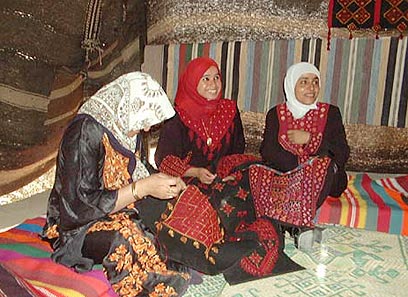
Bedouin Clothing
Bedouin Clothing
Bedouin Veils 
Bedouin Veils

For more information, click on the following links...
Geographia.com
Bedawi.com
Encyclopedia.com


Friday, October 12, 2012

The Geography of the Arabian Peninsula

the blue and red lines mark trade routes along the Silk Road
     Arabia lies at the crossroads of Asia, Africa, and Europe.  In ancient times, great civilizations grew up in the lands around Arabia.  To the northeast, Sumerians built their complex civilization along the valleys of the Tigris and Euphrates rivers in present-day Iraq.  To the west, the Egyptians built their society on the banks of the Nile River in North Africa. Later, the Greeks, Romans, and Persians all had a major influence on the Middle East.
The Desert 
Satellite image from NASA of the Saudi Arabian Desert.  The yellow lines enclose the desert area.
About 3/4s of the Arabian Peninsula is covered by desert.  the hot, dry environment is very harsh with summer temperatures above 120 degrees and droughts that can last for years, 
The Oases
The desert is dotted with oases, areas where fresh water is available.  Oasis are important because they provide plant life and shade as well.    
Oases occur in areas where water has been trapped underground.  The water seeps to the surface as a spring or waterhole.
The Coastal Plain
Arabia's Coastal plain runs along the coasts of the peninsula.
The coastal plain ranges between 5 and 40 miles inland.  It ends at a series of rocky cliffs.
The Mountains
Arabia's largest mountain ranges run along the western and southern edges of the peninsula.  They divide the coastal plain from the desert. 
Arabia's mountains rise from 1,000 to 12,000 feet high.  These mountain ranges have a very different climate from the rest of the peninsula.  Most winds from the Indian Ocean bring as much as 20 inches of rain each year.

Chapter 7 Vocabulary and Terms

caravan
a group of people with animals or vehicles who travel together for safety, especially through a desert
plateau
a large area of flat land that is higher than the land around it
nomad
a member of a tribe that travels from place to place instead of living in one place all the time, usually in order to find grass for their animals
nomadic (Bedouin) women
nomadic (Bedouin) woman wear their wealth
sedentary 
a sedentary group of people tend always to live in the same place
 barter 
to exchange goods, work, or services for other goods or services rather than for money

irrigation 
to bring water to a dry place in order to grow crops
women gathered around a water well
 terrace
one of a series of flat areas cut out of a hill like steps, and used to grow crops
This is an example of terrace farming in the Hazar Mountains of the Arabian Peninsula.  This is also an example of a sedentary community.