Thursday, October 11, 2012

The Arabian Peninsula

Chapter 7
OBJECTIVES 
Students will...
  • identify the physical features and describe the climate of the Arabian Peninsula, its relationship to surrounding bodies of land and water, and nomadic and sedentary ways of life.
  • explain how geography affected patterns of life on the Arabian Peninsula in the sixth century, including the role of towns and the establishment of trade routes to Asia, Africa, and Europe as well as the products that traveled along them.
Africa, Arabian subcontinent, and Eurasia
The Arabian Desert
Geography:  the climate, landscapes, physical features. water, and natural resources

Tuesday, October 9, 2012

Byzantine Art

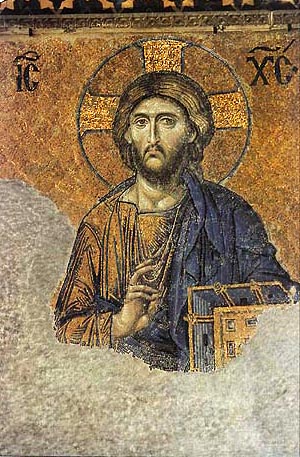
The most famous of the surviving Byzantine mosaics of the Hagia Sophia in Constantinople the image of Christ Pantocrator on the walls of the upper southern gallery. The mosaics were made in the 12th century. 
Mosaic from the church of Hagios Demetrios in Thessaloniki, late 7th or early 8th century, showing St. Demetrios with donors.
Miniatures of the 6th-century Rabula Gospel display the more abstract and symbolic nature of Byzantine art.
The Annunciation from Ohrid, one of the most admired icons of the Paleologan Mannerism, bears comparison with the finest contemporary works by Italian artists.
Miniatures of the 6th-century Rabula Gospeldisplay the more abstract and symbolic nature of Byzantine art.
Frescoes in Nerezi (1164)
Helios in his chariot, surrounded by symbols of the months and of the zodiac.  The "Handy Tables" of  Ptolemy, produced during the reign of Constantine V (1291)
Mosaic from San Vitale in Ravenna, showing the Emperor Justinian and Bishop Maximian of Ravenna surrounded by clerics and soldiers.
St Mark's Basilic in Venice, where imported Byzantine mosaicists were succeeded by Italians they had trained.


Constantinople

Map of Byzantine Constantinople 
Constantinople in Byzantine Times
Map of Constantinople (1422) by Florentine Cartographer Cristoforo Buondelmonte  
Artistic Map of Constantinople  

Monday, October 8, 2012

Columbus Day

Columbus Day, which is annually on the second Monday of October, remembers Christopher Columbus' arrival to the Americas on October 12, 1492. This holiday is controversial because the European settlement in the Americas led to the demise of the history and culture of the indigenous peoples.


Officially, the people of the USA are invited to celebrate the anniversary of the discovery of their country with church services and other activities. In some towns and cities, special church services, parades and large events are held. Most celebrations are concentrated around the Italian-American community. The celebrations in New York and San Francisco are particularly noteworthy. In Hawaii Columbus Day is also known as Landing Day or Discoverer's Day.
Not all parts of the United States celebrate Columbus Day. It is not a public holiday in California, Nevada and Hawaii. Moreover, Native American's Day is celebrated in South Dakota, while Indigenous People's Day is celebrated in Berkeley, California. 
For more information on Native American's Day click here.

Wednesday, September 26, 2012

Chapter 6 Vocabulary & Terms

schism

a formal division in a church or religious body over a disagreement about beliefs
icon
a picture or a statue of a religious figure, usually painted on wood, usually painted with melted gold
liturgy
a way of praying at a public service or the written form of these services
patriarch
1. the male head of a family or tribe
2. a bishop of high rank in the Eastern Orthodox Church
Publicity photograph for the 1950's television show Father Knows Best.
public works
public buildings built and paid for by the government
examples... hospitals, bridges, roads, public schools 
The Golden Gate Bridge under construction in 1937, when an era of huge public works projects was under way.
Byzantine Empire 
After the fall of the Roman Empire, the eastern half lived on for another 1,000 years as the Byzantine Empire.
Constantinople
The capital city of the Byzantine Empire.  Today it is known as Istanbul, the capital city of Turkey.


Eastern Orthodox Church
Following the Great Schism, this church broke away from the Catholic Church and became the official church of the Byzantine Empire. 
Justinian I and Theodora
Justinian I was one of the greatest emperors of the Byzantine Empire.  Theodora was his beautiful and intelligent wife.

Tuesday, September 25, 2012

The Byzantine Empire

Chapter 6
OBJECTIVES
Students will...
  •  explain the importance of the city of Constantinople as a trading hub and how mit emerged as the capital of the Byzantine Empire.
  • describe the importance of the reign of Justinian I and the lasting impact of the new code of laws organized during his reign.
  • trace the development of the Eastern Orthodox Church and its relations to the west.


Constantine


The Fall of the Roman Empire

The Legacy of the Roman Empire

Tuesday, September 18, 2012

Chapter 3 Vocabulary

proverb
a short well-known statement that gives advice or expresses something that is generally true
dome
a round roof on a building
vault
a roof or ceiling that consists of several arches hat are joined together, especially in a church
aqueduct

a structure like a bridge, that carries water across a river or valley

scribe
someone in the past whose job was to make written copies of official documents
philosophy
the study of the meaning of existence, truth, good and evil, etc
mosaic
a pattern or picture made by fitting together small pieces of coloured stone, glass etc
cathedral
the main church of a particular area under the control of a bishop
mural
a painting that is painted on a wall, either inside or outside the a building
fresco
a painting made on a wall while the plaster is still wet